Places impact you for a variety of reasons. And the same place impacts different people in different ways. This is especially true when it comes to spiritual experiences, where every single person’s experience is unique. And personally, every spiritual experience is unique, the same person can have different deeply spiritual experiences at different places, at different times. This thought has emerged because of my own experiences over the years, but especially so this year, with different and unique experiences at various places I have visited recently. I began this year with a visit to Baroda (Vadodara) with friends. It was meant to be a relaxed trip, a touristy trip, with our sons. We enjoyed ourselves to the hilt, but the highlight of that trip was a visit to the Lakulisha temple at Pavagadh. It was the iconography of the temple that I connected with, and I spent a few hours simply lost in the details of the figures carved around the temple. There was an indefinable connect with
A question I was regularly asked at one time was:”So, you are a Tamilian. You must have learnt classical music and Bharatanatyam, right?” It was a question which always succeeded in irritating me, for I had nothing to do with either music or dance, despite being a Tamilian. Yes, my mom had, true to tradition, tried to get me interested in music. I had endured the classes for a year, and soon after, telling my mom that the classes intruded into my reading time, had refused to go anymore. She would have loved to send me to Bharatanatyam classes, but that was something I had no interest in even trying! Having two left feet, I stayed away from dance of all kinds, and she soon gave up, leaving me to my literary pursuits. Living in a place where there were hardly any cultural events, and even fewer related to our South Indian background, I grew up blissfully ignorant of Carnatic music and Bharatanatyam. Then, I got married and shifted to a predominantly South Indian neighbourhood – one which could actually be called a miniature Madras, complete with temple and all! Here were more people surprised that I wasn’t remotely interested in the classical arts, except as a spectator, all the more so since my sister-in-law herself was an accomplished Bharatanatyam dancer! Years passed and I began enjoying Bharatanatyam performances, now that I was actually attending more of them, and besides, my sister joined the dancing brigade too. However, I still maintained my distance, being just remotely interested in the performance and the talent of the dancers. All that changed when my sister-in-law asked me for help in translating some documents for her Masters degree in the dance, and I discovered what a wealth of history and literature was available behind the ancient dance form. I began reading my sister-in-law’s books, eager to learn more about those who had shaped the dance and brought it to the form in which it is known today.


This review is a part of the Book Reviews Program at BlogAdda.com. Participate now to get free books!
Photos Courtesy: Internet

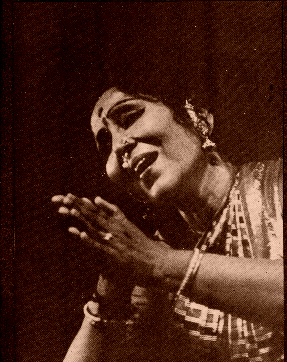
Among the many dancers I read about, one name stood out – Balasaraswati. She was said to be the first to perform the dance outside south India, but I was intrigued even more when I read an article which mentioned that she often sang as she danced! And then, a couple of weeks back, I saw that the book ‘Balasaraswati – Her Art and Life’ was up for review on Blogadda. I had been a part of the Blogadda Book Review programme for quite a while, but I had yet to receive a book for reviewing, so it was with some indifference that I applied for this one, thinking that I had nothing to lose. Besides, I was leaving for Samhith’s thread ceremony, and didn’t really have time to do a review! Imagine my surprise when I got a mail from them, saying that I had been among the lucky ones chosen!! For a while, I wondered if I should refuse, since I hardly had time to read such a book and review it in the short time I had, but then the temptation proved too strong, and I agreed! So here at last (though a bit belated) is the review of ‘Balasaraswati – Her Art and Life’, by Douglas M. Knight, Jr.

Any biography of Balasaraswati was bound to be interesting. However, this book is even more so, because of the author. He is not only an accomplished musician, who has appeared in performances with Balasaraswati, her brothers, her daughter, as well as her grandson, but he also has the privilege of being her son-in-law! He thus brings in his intimate knowledge of the family, which gives the book a personal feel – a feel of a story told by a member of the family.
The book takes us through Balasaraswati’s life as well as her dance, beginning with her ancestors as well as the history of dance in South India. We learn of the evolution of the dance form, as well as the changing circumstances of Balasaraswati’s family and their moving to Madras from Thanjavur. Knight has painstakingly put together the family history, from the times of Thanjavur Papammal, Balasaraswati’s great-great-great-great-grandmother, who was a dancer and musician in the Thanjavur court, to Veena Dhanammal, Balaraswati’s grandmother and exceptional musician, whose prefix ‘Veena’ indicated her mastery of the instrument! Jayammal, Balasaraswati’s mother may not herself have been as famous as her mother, or later, her daughter, but we learn from Knight that it was at her insistence that Balasaraswati was trained as a dancer, despite strong family opposition. Reading the book, for the first time, I appreciated and understood the situation at the time, which made people shy away from teaching their daughters dance, preferring them to learn music instead! Jayammal must indeed have been an unconventional and strong woman to have insisted that her daughter learn not just music, but dance too! So it was that Balasaraswati began her education in music and dance at the tender age of 4!

Reading the book further, about Balasaraswati’s education, and her first public performance or Arangetram, I couldn’t help but contrast the situation with that today. I live in an area where every other young girl learns Bharatanatyam, and even performs her Arangetram, but the idea is not to master the art, but to add another accomplishment to their repertory of ‘extra-curricular activities’. Reading about Balasaraswati being branded by hot coal for a mistake in performing a particular gesture, or about being tested every single day, made me think about her dedication and single mindedness, which helped her accept such harsh conditions, and also made me wonder if any of the young students today were even aware of the colossal effort that went into making a young girl a perfect dancer! Reading about the Arangetram itself was interesting – today, it involves performing for three hours in front of an audience which mostly consists of friends and relatives who know nothing about the dance, and just a few special guests who are experts, and who, no matter how good or bad the performance, repeat the same congratulatory remarks. Imagine then, an Arangetram, which involved the entire community – a performance which had to be evaluated, reviewed and tested by the elders! She first performed for the women in the morning, then the next day for the experts in the field, and then again in the evening for a mixed group of men and women, and then finally, in the presence of the deity, a culmination of the performance. At every stage, she was questioned and tested, a continuous test of skills, so to speak! And all this at the age of seven!!! Can any of you even imagine such dedication or commitment in any field today?
As we travel further in time, reading about her journey in dance, about her struggles and her achievements, singing her dancing her way across difficult times, coping with the stigma of being called a ‘devadasi’, as well as ill health, it is impossible not to feel admiration and awe for the woman who took Bharatanatyam across the world! At the rate at which I am going, I will probably go on and on and tell you the entire story as well as my thoughts, but unfortunately, I am now running short of time, so I shall stop myself here, leaving you to go ahead and read the book yourself to know more about such a remarkable dancer. But, before I sign off, just a couple more things need to be said....
The book is meant to be a detailed biography, and it stays true to Balasaraswati, but an admirable fact is the detailed history which helps us understand her better. At every stage, Knight makes sure we understand the situation at the time, with detailed historical events as well as descriptions of the locations involved. I could almost imagine Madras as it was then, his descriptions bringing back memories of my grandfather talking about the old city. The old photographs Knight has unearthed help too, in bringing the people we are reading about to life. As I turned the pages, I found myself wishing that I could have attended at least one of her performances!!
This book is a useful one for dancers and those interested in learning more about the dance, for sure, but the book is also an easy read – one anyone even remotely interested can read, and enjoy!
Photos Courtesy: Internet
I have been checking out the different reviews of this book, Anu, and find that this book has made quite an impact on the reviewers. Isn't it? Nice one, Anu :-)
ReplyDeleteA literary interest in dance, I do not even have that and I too surely have two left foot. But I can see you enjoyed the book from your review.
ReplyDeleteYour copmmentary was something special.
ReplyDeleteWriting/Reading a book that doesnt really interest and being able to review it so lucidly...woman, you really write well...Thank You....I usually love the old sepia's and costumes that go with such books...i am sure it isan interesting addition to your collection
ReplyDeleteNice & enjoyable review Anuradha. You have captured the essence of the book in your own inimitable style. Makes one want to read the book.
ReplyDeleteA great legend...
ReplyDeleteahmedabadonnet.com
Staggering isn't it the depth of culture behind each dance form.
ReplyDeleteYou added a value to the subject and bring it to a layman's notice to its overwhelming extremity and its obsolete importance that we sometimes forget.
ReplyDeleteNice Review - I had enjoyed this book too - was lucky enough to receive it from Bloagadda...BTW I enjoy reading your travelogues....have your blog on my google reader :)
ReplyDeleteThanks Zephyr~ Its a wonderful book with some amazing details which make her come alive... can lend u the book if u want to read!
ReplyDeleteIt was nice reading, Mridula!
ReplyDeleteThanks Sowmya.....
ReplyDeleteThanks a lot!
ReplyDeleteThanks SRS! saw ur message late, so heading over to read ur review of the book now!
ReplyDeleteAbsolutely, Anil!!
ReplyDeleteThanks a lot, Sunil!
ReplyDeleteher voice is blasticcccccccccc
ReplyDelete